7 Hells of Beppu: Walking Order, Timing, Tickets and Which to Skip (2026)
How to walk the 7 hells of Beppu in order: a timed route through Kannawa's five, the bus to Chinoike and Tatsumaki timed to the geyser, the ¥2,400 ticket math, Kamenoi passes, the lore, and an honest list of which hells disappoint.

The 7 hells of Beppu (別府地獄めぐり, Beppu jigoku meguri) are seven boiling springs you look at rather than bathe in: a cobalt-blue lake, a pond the colour of blood, grey mud that blows bubbles like a monk’s bald head, and a geyser that goes off every 30 to 40 minutes. Five sit within a few minutes’ walk of each other in Kannawa; the other two are a short bus ride north in Shibaseki. Done in the right order they take about three hours and ¥2,400. Done in the wrong order, you’ll spend 40 minutes staring at a quiet hole in the ground waiting for the geyser. This guide gives you the order, the timing, the ticket math, the stories behind the name, and an honest list of which hells you can skip.
If you’d rather have a bus do the thinking, our Beppu day tour guide from Fukuoka compares the guided options; this page is for walking it yourself.
Quick answer: order, time, cost
| Detail | |
|---|---|
| Order | Umi → Oniishibozu → Kamado → Oniyama → Shiraike (Kannawa, on foot), then bus 16 to Chinoike and Tatsumaki (Shibaseki) |
| Time | 1.5 to 2 h for Kannawa’s five, 45 to 60 min for Shibaseki’s two, about 3 to 3.5 h in total with the bus |
| Hours | 8:00 to 17:00, every day of the year, all seven hells |
| Combined ticket | ¥2,400 adult, ¥1,200 elementary and junior high, valid two days, sold at any hell |
| Single hell | ¥500 adult |
| Bus | Kamenoi 1-day Mini pass ¥1,100 adult (¥550 child), or pay per ride |
| Guided alternative | Kamenoi’s hell-tour sightseeing bus from Beppu Station, 9:20 and 14:00, about 3 h, ¥4,500 adult with entry included |
Hours and prices are from the Beppu Jigoku Association’s fee page (prices current from 1 February 2025) and Kamenoi Bus, checked 22 October 2026.
The seven hells at a glance
| Hell | Colour and temperature | What’s there | Minutes | Verdict |
|---|---|---|---|---|
| Umi (Sea Hell) | Cobalt blue, about 98°C | The biggest pool, giant water lilies in a heated greenhouse, free foot bath, steamed eggs | 30 | Keep. The one that justifies the trip |
| Oniishibozu (Monk’s Head Hell) | Grey mud, about 99°C | Mud domes that rise and pop, a real bathhouse next door | 15 | Keep, it’s next door to Umi anyway |
| Kamado (Cooking Pot Hell) | Six pools from rust red to cobalt blue, about 98°C | Pools “1-chome” to “6-chome”, a steam demonstration, throat and skin steam, drinkable spring, foot bath | 20 | Keep. The best one for kids |
| Oniyama (Devil Mountain Hell) | Clear, steaming | About 70 crocodiles kept on hot-spring heat since 1923 | 15 | Skip unless it’s Saturday or Sunday at 10:00 (feeding) |
| Shiraike (White Pond Hell) | Milky blue-white, about 95°C at source | A small garden, a tropical fish house with 4 m arapaima | 15 | Quick look. The weakest of the seven |
| Chinoike (Blood Pond Hell) | Brick red, about 78°C | Japan’s oldest recorded hell, a red-clay skin ointment, free foot bath | 25 | Keep |
| Tatsumaki (Waterspout Hell) | Geyser, about 105°C | Erupts for 6 to 10 min every 30 to 40 min, under a roof | 10 to 40 | Only if the lamp says the next eruption is soon |
Temperatures and features come from the association’s pages for each hell, linked below.
Kannawa’s five on foot
Take a Kamenoi bus 2, 5, 24 or 41 bound for Kannawa from the west exit of Beppu Station, about 20 minutes, and get off at Umi Jigoku-mae (official access page). The five hells run downhill from there, so this order never makes you climb back up.
9:00, Umi Jigoku (海地獄), 30 minutes. The pool is about 98°C and the water comes from 200 m down; the blue is dissolved iron sulphate. The lake sits in a garden with a greenhouse where giant Amazon water lilies grow on geothermal heat, best from May to early November and in the morning. The shop sells hot-spring eggs (¥450 for five) and a steamed pudding (¥400), and the foot bath is free (Umi Jigoku page). Local sources date the pool to the eruption of Mount Tsurumi in 867, which makes it about 1,200 years old (tabi-mag). Arrive at opening and you’ll have the steam to yourself; by 10:00 the tour buses have landed.
9:35, Oniishibozu Jigoku (鬼石坊主地獄), 15 minutes. Next door. Grey mud at about 99°C swells into smooth domes and pops, which is where the “monk’s shaved head” name comes from. The big vent that roars is nicknamed oni no takaibiki, the demon’s loud snoring. The hell was a Meiji-era attraction called Shin-Bozu Jigoku, closed, and reopened in 2002 under its present name. It also runs Oniishi no Yu, a proper bathhouse with cypress and rock baths, ¥620 for adults (Oniishibozu page; Mapple).
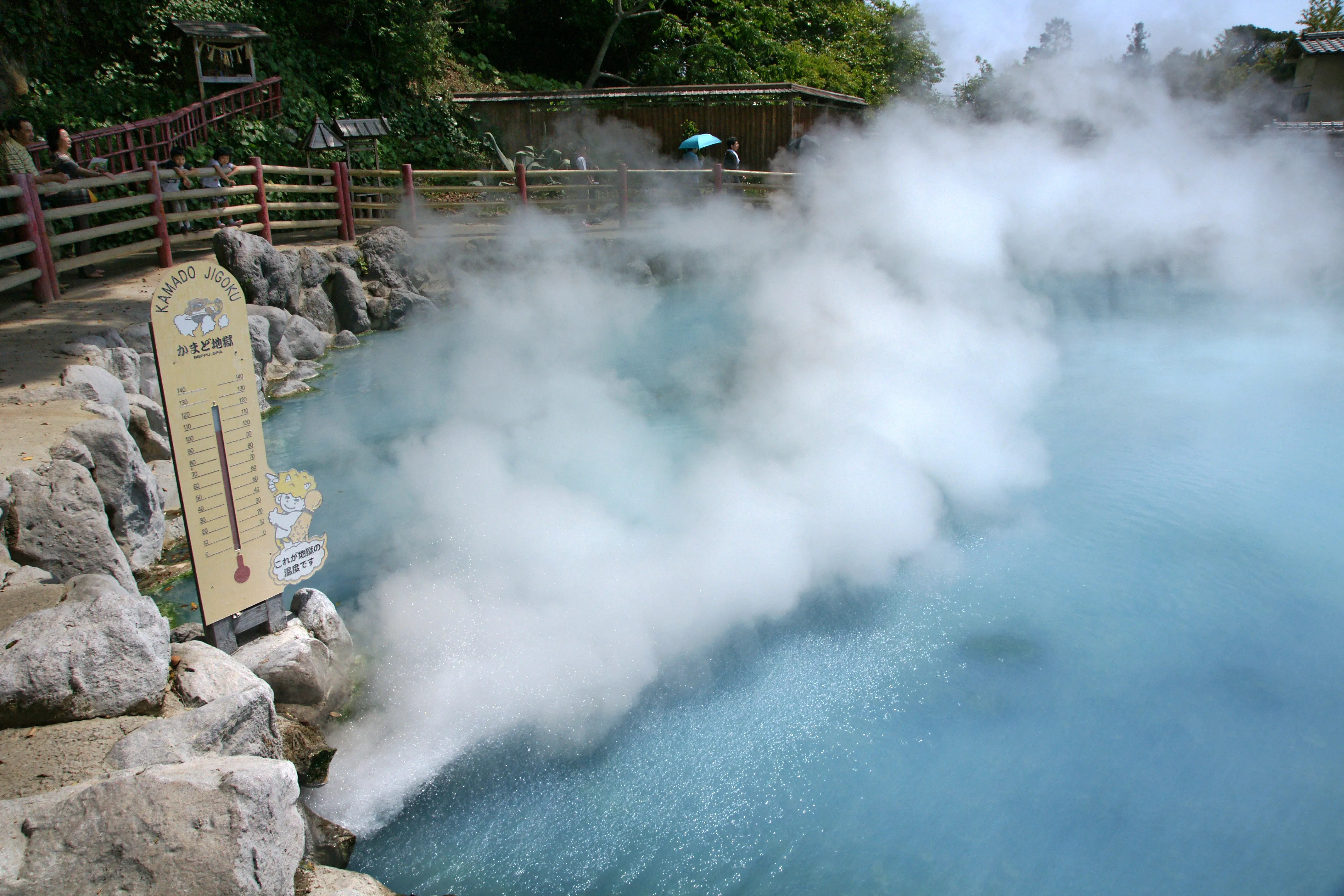
9:55, Kamado Jigoku (かまど地獄), 20 minutes. Five minutes’ walk down the road. The name is literal: for centuries the 98°C steam here cooked the rice offered at the festival of the local shrine, Hachiman Kamado Jinja (Kamado Jigoku page). It’s six small hells in one, numbered like city blocks: 1-chome is rust red, 2-chome a steaming rock pile with the red demon statue on a cooking pot, 3-chome a cobalt-blue pool like a small Umi (this is the hell in the photo above), 4-chome a mud volcano, 5-chome a pool that shifts between green and blue, and 6-chome a thick mud pot that burps (tabi-mag). Staff do a party trick with a puff of smoke whose particles seed the invisible steam so it suddenly billows white, and there are steam vents you breathe or hold your face over, an 80°C drinking spring, and a foot bath.
10:20, Oniyama Jigoku (鬼山地獄), 15 minutes. A minute further on. Since 1923 the hell has used its hot-spring heat to keep crocodiles, the first place in Japan to do so; about 70 live here today. The original Ichiro lived to 71, a world longevity record for the species at the time, and died in 1996. Feeding is Saturdays and Sundays at 10:00 (Oniyama page). On any other day the crocodiles don’t move, and the enclosures feel their age.
10:40, Shiraike Jigoku (白池地獄), 15 minutes. The water comes out clear at about 95°C and turns milky white as it loses heat and pressure falling into the pond. There’s a small Japanese garden and a tropical fish house with piranhas and arapaima that grow to 4 m (Shiraike page). It’s one of the four National Places of Scenic Beauty, which surprises people, because it’s the least dramatic hell on the circuit.
11:00. You’re at the bottom of the hill, a short walk from the Kannawa bus stop and from the steam kitchen (see lunch, below).
Weekend variation. If it’s Saturday or Sunday, do Umi at 8:00 when it opens, then Oniishibozu, then walk straight to Oniyama for the 10:00 feeding, and take Kamado and Shiraike afterwards.
Getting to Chinoike and Tatsumaki
The two Shibaseki hells are about 3 km north. From the Kannawa bus stop take Kamenoi bus 16 and get off at Chinoike Jigoku-mae (official access page); the ride is a few minutes. The two hells are next to each other.
Do this first: walk to the gate of Tatsumaki Jigoku (龍巻地獄) and look at the lamp. The geyser erupts every 30 to 40 minutes for 6 to 10 minutes, and a red lamp at the entrance lights up when an eruption is imminent or under way (Tatsumaki page; interval per tabi-mag). If an eruption is due within 10 minutes, go in now. If it just finished, go to Chinoike and come back. The water leaves the ground at about 105°C with enough force to reach 30 m; a stone roof catches it a few metres up, which is why the eruption looks smaller than the number suggests. The shop sells gelato and juice from the hell’s own mandarin grove.
Chinoike Jigoku (血の池地獄) is the one you’d pick for a horror film: 1,300 m² of brick-red water at about 78°C, 30 m deep, coloured by hot clay full of iron and magnesium oxides. It’s Japan’s oldest recorded natural hell (more on that below). The shop sells Chinoike nanko, a skin ointment made from the red clay, and the foot bath is free (Chinoike page). The pond blew up repeatedly between the 1870s and the 1920s; today it’s stirred to keep it calm (tabi-mag).
Leaving Shibaseki: bus 16 back to Kannawa for lunch, or walk 25 minutes (or a 7-minute bus) to Kamegawa Station, one local stop from Beppu (about 5 minutes, ¥200).
Tickets: combined, single and bundles
- Combined ticket (共通観覧券): ¥2,400 adult (high school and up), ¥1,200 elementary and junior high. Groups of 20 or more pay ¥2,000 and ¥1,000; holders of a disability certificate pay half. Sold at every hell, valid for the day of purchase and the following day, so you can split the circuit over two mornings (fee page).
- Single admission: ¥500 per hell for an adult, as listed by LIVE JAPAN and other guides. Seven singles would be ¥3,500, so the combined ticket wins from the fifth hell. For Umi plus Chinoike only, pay ¥1,000 at the gates.
- Website coupon: the association posts a printable discount coupon, valid for up to five people and accepted on a phone screen. The amount is printed on the coupon itself.
- Ticket plus bus pass: Klook sells the seven-hell ticket bundled with a Kamenoi 1-day Mini pass; note that the listing collects at Fukuoka Airport’s international terminal, so it’s for people flying in, not for a last-minute buy in Beppu.
Kamenoi day passes and the guided hell-tour bus
Kamenoi’s 1-day Mini pass covers every Kamenoi route inside Beppu city, including the station-to-Kannawa buses and bus 16 to Shibaseki, for ¥1,100 adult, ¥900 youth, ¥550 child. It’s an e-ticket you show the driver; express and airport buses are excluded (Kamenoi web ticket). Older fare listings put the single station-to-Kannawa ride at a few hundred yen, so two rides plus the Shibaseki hop make the pass roughly break even, and it stops you fumbling for coins.
The guided hell-tour bus (別府地獄めぐりコース) is the descendant of the original 1928 service. It leaves Beppu Station at 9:20 and 14:00, takes about 3 hours depending on traffic and the geyser, and costs ¥4,500 adult, ¥3,500 junior high, ¥2,300 elementary and under, with all seven admissions included. A bus guide walks you around Kannawa’s five for about an hour and the bus does the rest; book online or by phone (Kamenoi course page). Against ¥2,400 plus ¥1,100 for doing it yourself, you’re paying about ¥1,000 for the guide and the timing. The commentary is in Japanese.
For the full guided day from Hakata, with the train or coach handled too, see the Beppu day tour guide or browse current Beppu day tours on Klook.
Why they’re called hells: the fudoki, Kumahachi and the crocodiles
The name is older than tourism. The Bungo no Kuni Fudoki, the provincial gazetteer of Bungo compiled in the 730s, describes the springs of this district: a “Kuberi no Yu” that the association identifies with Umi Jigoku, and a “red hot spring” that is Chinoike, which is why Chinoike is called Japan’s oldest natural hell (the association’s scenic-beauty page). For a thousand years after that the ground here was wasteland people kept away from, steam and boiling mud erupting out of nowhere, which is how “hell” stuck; local tradition credits the 13th-century monk Ippen with calming the hells and founding Kannawa as a spa (Oita tourism).
Turning hell into a day out was the work of Aburaya Kumahachi (1863 to 1935), who opened the Kamenoi inn in 1911, climbed Mount Fuji in 1925 to plant a sign reading “Fuji for mountains, the Seto Inland Sea for sea, Beppu for hot springs”, and in January 1928 founded Kamenoi Jidosha, today’s Kamenoi Bus, to run Japan’s first scheduled sightseeing bus with female guides. Its route was the hell tour (tabi-mag on Kumahachi). Hence the two buses a day that still leave the station, and the guide who still walks you round Kannawa. His house rule, “treat the traveller with care” (旅人を懇ろにせよ), is still quoted in Beppu.
The crocodiles are the odd one out and also the most Beppu thing about Beppu: in 1923 Oniyama Jigoku worked out that a 98°C spring could keep tropical reptiles alive through a Kyushu winter, and nobody has seen a reason to stop since.
In 2009 the national government designated four of the hells, Umi, Chinoike, Tatsumaki and Shiraike, a National Place of Scenic Beauty (名勝) as “Beppu no Jigoku”, for the unusual range of colour and form in their springs. It was Oita’s first such designation in 86 years, since Yabakei Gorge in 1923 (scenic-beauty page).
Jigoku-mushi lunch and the Jigoku Onsen Museum
Kannawa cooks with the same steam. At Jigoku-mushi Kobo Kannawa (地獄蒸し工房 鉄輪), the city-run steam kitchen on Ideyu-zaka, you rent a steamer, lower a basket of vegetables, seafood, eggs or dumplings into the vent for 10 to 15 minutes and eat at the long tables. Hours are 10:00 to 19:00 (last order 18:00), closed the third Wednesday; there are no reservations, you take a numbered ticket and wait, which at 12:30 on a weekend means a long wait, so go at 11:00 straight from Shiraike or after 14:00 (official site). Third-party listings put the steamer fee at about ¥400 for 15 minutes plus the ingredients (rurubu). The foot bath in the pocket park next to it is open 10:00 to 18:00.
The Jigoku Onsen Museum (地獄温泉ミュージアム), opened in December 2022 beside Umi Jigoku, tells the 50-year journey of a raindrop through the mountain into a hot spring and explains why this patch of ground steams. Adults ¥1,500, children ¥1,000; show a combined hells ticket and it drops to ¥1,050 and ¥700. There’s also a three-site set (museum plus Umi plus Oniishibozu) at ¥1,900 adult. Open 9:00 to 18:00, last entry 17:30 (museum site). It’s the right rainy-day add-on and the right thing to do while you wait for the steam kitchen.
Which hells disappoint
The Japanese search “別府地獄めぐり がっかり” (Beppu hells, disappointing) gets a couple of thousand searches a month, so let’s answer it. The complaints that recur in Japanese reviews, and that I’d second, are these (one honest Japanese write-up):
- Tatsumaki is overhyped. You wait up to 40 minutes, the eruption is caught by a roof a few metres up, and the rocks around the vent hide half of it. It’s a geyser, which is rare in Japan, but it’s not Iceland. Go in only when the lamp says it’s imminent.
- Shiraike and Oniyama are small and dated. Shiraike’s draw is a fish tank; Oniyama’s crocodiles sleep six days a week. Both are five minutes of looking.
- Oniishibozu is subtle. The mud domes are the size of dinner plates. If you’re expecting Rotorua, lower the bar; if you listen for the snoring, it’s fun.
- The whole thing is small-scale and busy. Each hell is a garden-sized site; on a weekend afternoon you’re shuffling behind a tour group at every rail.
- Singles are poor value. ¥500 for a five-minute hell stings. Buy the combined ticket or pick two.
What doesn’t disappoint: Umi’s colour, Chinoike’s colour, and Kamado’s variety. If you have an hour, do Umi and Kamado (¥1,000, next to each other). If you have 90 minutes, Umi and Chinoike. If you have a morning, do all seven in the order above and you’ll have seen the best of them before the crowds.
Getting there from Fukuoka and Kokura
- From Hakata: the Sonic limited express runs direct to Beppu in about 2 hours; the regular fare is ¥6,910 reserved or ¥6,380 non-reserved. Booked three days ahead online, JR Kyushu’s Kyushu Net Hayatoku 3 cuts a reserved seat to ¥2,950, and the 2-ticket nimai kippu is ¥8,500 for two one-way non-reserved rides from Fukuoka city, valid seven days (Sonic fare table, October 2026). The JR Kyushu Northern Kyushu Rail Pass covers it.
- From Kokura: the same Sonic, about 1 hour 10 to 20 minutes, ¥5,190 reserved or ¥4,660 non-reserved. Beppu is an easy day from Kitakyushu: Sonic out at 8:00, hells by 9:30, back by dinner.
- At Beppu Station: use the west exit for the Kannawa buses (routes 2, 5, 24 and 41). Buy the Mini pass as an e-ticket on Kamenoi’s site before you board.
Coming from Fukuoka with Yufuin on the same trip? Our Fukuoka to Yufuin and Yufuin day tour guides cover the other side of the mountain; the Sonic-via-Oita route serves both.
Staying in Kannawa is the way to beat the crowds: you walk into Umi at 8:00 from your ryokan and have breakfast at the steam kitchen. Compare Kannawa ryokan on Booking.com or Agoda.
FAQ
How long do the 7 hells of Beppu take? About 3 to 3.5 hours for all seven including the bus. Kannawa’s five take 90 minutes to 2 hours; Chinoike and Tatsumaki take 45 to 60 minutes, mostly geyser waiting.
How much is the combined ticket? ¥2,400 adult, ¥1,200 elementary and junior high, valid two days, sold at any hell. A single hell is ¥500.
What’s the best order? Umi, Oniishibozu, Kamado, Oniyama, Shiraike downhill from the Umi Jigoku-mae bus stop, then bus 16 to Chinoike Jigoku-mae. Check Tatsumaki’s lamp before you choose between the last two.
Which hells can I skip? Oniyama (except weekend 10:00 feeding), Shiraike, and Tatsumaki unless an eruption is minutes away. Umi, Kamado and Chinoike are the keepers.
Can I bathe in them? No, they’re 78 to 105°C. Every hell has a free foot bath, and Oniishibozu has a real bathhouse for ¥620.
Three hours, seven gates, one bus ride, and you’ve walked through 1,300 years of people being frightened of this hillside and then, from 1928, paying to see it. Go early, read the lamp, and skip what you’re allowed to skip.
Check Beppu hells tickets and bus passes on Klook →Booking through this link supports KitaQ.Travel’s research and photography at no extra cost to you.
Every Fukuoka and Kitakyushu day trip we’ve covered is on the tours hub, and the Beppu day tour guide is the guided version of this page.
FAQ
How long does it take to see all 7 hells of Beppu?
About 3 to 3.5 hours for all seven, including the bus between the two areas. Kannawa's five take 90 minutes to 2 hours on foot; Chinoike and Tatsumaki take 45 to 60 minutes, most of it waiting for the geyser, which erupts every 30 to 40 minutes.
How much is the Beppu hells combined ticket?
¥2,400 for adults (high school and up) and ¥1,200 for elementary and junior high students, as of February 2025. It covers all seven hells, is sold at any of them, and is valid for two days: the day you buy it and the next. A single hell is ¥500 for an adult, so the combined ticket pays off from the fifth gate.
What is the best order to visit the Beppu hells?
Start at the Umi Jigoku-mae bus stop and walk downhill: Umi, Oniishibozu, Kamado, Oniyama, Shiraike. Then take Kamenoi bus 16 from the Kannawa stop to Chinoike Jigoku-mae. At Shibaseki, check Tatsumaki's posted eruption time first, and fit Chinoike around it.
Are the Beppu hells worth it, or disappointing?
Umi, Chinoike and Kamado are worth it for almost everyone. Tatsumaki is the one most visitors find overhyped: a 30 to 40 minute wait for a geyser capped by a roof. Shiraike and Oniyama are small and dated unless you catch the Saturday or Sunday 10:00 crocodile feeding. If you only have an hour, do Umi and Kamado for ¥1,000.
Can you bathe in the Beppu hells?
No. The hells are for looking at: Umi and Kamado are around 98°C, Oniishibozu about 99°C, Chinoike about 78°C. Every hell has a free foot bath instead, and Oniishibozu runs a real bathhouse, Oniishi no Yu, for ¥620.
Photo credits
- Steam pouring across the pale blue pool of Kamado Jigoku, the Cooking Pot Hell, with its painted thermometer signboard on the rocks and visitors at the railing: 663highland, CC BY 2.5, Wikimedia Commons
