Fukuoka Night View Spots: Where to Shoot the City After Dark (2026-27)
Ten Fukuoka night view spots by train and bus, with what to frame, when to arrive, hours, fees, tripod and drone rules in each venue's words, the 2026-27 illumination calendar and three evening routes.

The best Fukuoka night view is not one place. It’s a coastline of them: a mirrored tower at the west end of a beach, a shrine on a hill that has watched the bay since the first century, two free observation decks nobody tells you about, a river island that glows from the stalls along its banks, and a station roof that opens onto the whole of Hakata. I moved to Moji-ku in 2024 and Fukuoka is my big-city evening out, so this is the list I give friends who arrive with a camera: what to frame at each spot, when the light is right, how to get there by train or bus, what it costs, and the tripod and drone rules in each venue’s own words. All of it checked on 29 October 2026.
The quick answer
| Spot | What to shoot | Best time | Cost | Tripod | Nearest stop |
|---|---|---|---|---|---|
| Fukuoka Tower | City grid and bay from 123 m | Blue hour inside, then full dark | ¥1,000 | Refused (tower FAQ) | Bus to TNC Hoso Kaikan-mae |
| Seaside Momochi | The tower lit over the sand | Sunset to 23:00 | Free | Beach, fine; no drones (city parks) | Same bus, or Nishijin Station |
| Washio Atago Shrine | Tower, expressway curves, bay | Sunset | Free | Not stated | Muromi Station |
| Nishi Park | Hakata Bay from the new deck | Blue hour, till 21:30 | Free | Not stated | Ohorikoen Station |
| Ohori Park | Nakanoshima lights on the pond | 18:00 to 22:00 | Free; ¥1,980 permit for paid shoots | Not stated for personal use | Ohorikoen or Tojinmachi |
| Fukuoka Castle Ruins (teamLab) | Lit stone walls, 1601 | 30 Oct to 11 Jan, after 18:15 | ¥2,300 / ¥2,500 | Check the organiser’s list | Ohorikoen or Akasaka |
| Nakasu riverside | Island skyline from the Deai Bridge | 17:00 onward | Free | Fine on the bridge | Nakasu-Kawabata |
| JR Hakata City rooftop | Hakata from the station roof | Till 22:00 | Free | Not stated | Hakata Station |
| Hakata Port Tower | Bay and ferries from 70 m | Sunset, before 20:00 close | Free | Not stated | Bus to Hakata Futo |
| Fukuoka Airport deck | Runway lights, landings | Till 22:00 | Free | Not stated; no drones (law) | Fukuoka Airport Station |
When to shoot: sunset by month
Fukuoka sits far enough west that winter sunsets come later than Tokyo’s. The sun sets around 17:25 on 1 November, about 17:15 mid-month, around 17:10 at the end of November and between 17:10 and 17:20 right through December; the National Astronomical Observatory publishes exact times for Fukuoka on its calendar page. The shot you want is blue hour, the 20 to 30 minutes after sunset when the sky still holds colour and every light in the city is already on. In winter that means being in position by 17:00 and finished with the “good” light by 18:00, which is why the routes at the end of this guide start early and end late.
Air clarity matters more than the calendar. Cold dry nights after a front passes are the ones where you see Shikanoshima from Nishi Park and the Itoshima hills from the tower. Summer haze softens everything.
The spots, west to east
Fukuoka Tower
Fukuoka Tower was built as the monument of the 1989 Asia-Pacific Exposition, “Yokatopia”, the fair that turned a reclaimed sandbank into the Momochi district. It is 234 m tall, the tallest seaside tower in Japan, and its triangular shaft is skinned in 8,000 half-mirror panels, which is why locals call it the Mirror Sail (Fukuoka Prefecture tourism feature). The observation floors are at 116, 120 and 123 m.
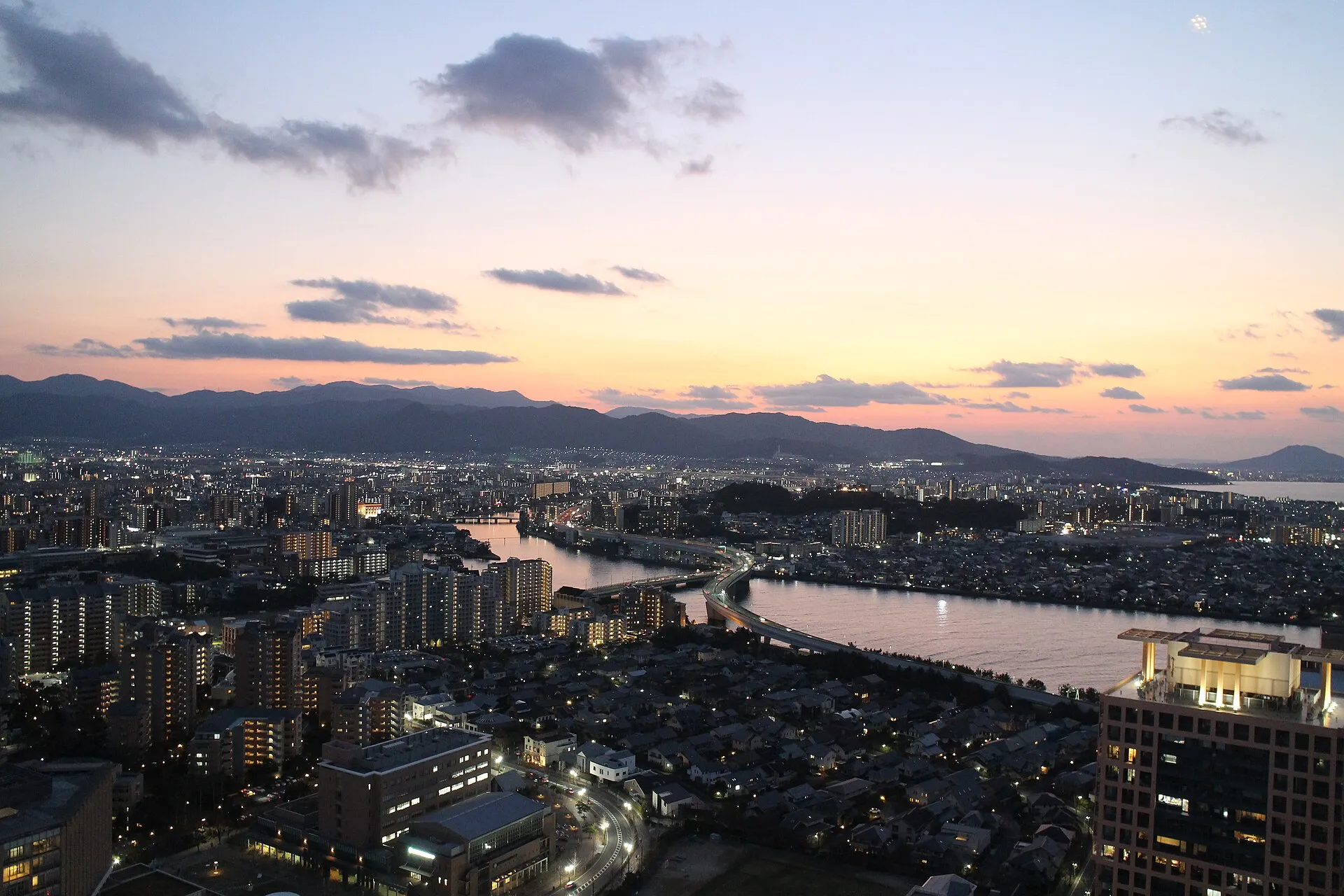
What to shoot. From the top floor the city reads as a grid of light running east to Hakata, with the black of the bay to the north and, on a clear evening, the Itoshima coast fading west. Go up 30 minutes before sunset, take the west-facing windows for the sun over the sea, then move to the east side for blue hour over the city. Press the lens against the glass and shade it with a sleeve or a dark cloth: the windows reflect the room’s lighting.
Rules, in the tower’s words. The FAQ answers “Can I shoot with a tripod in the observation room?” with 三脚を使用しての撮影はご遠慮いただいております (tripod photography is refused), there is no re-entry once you leave, and there’s no limit on how long you stay. For a pre-wedding shoot or any commercial work there’s an application form, and the answer depends on method, place and date (Fukuoka Tower FAQ).
Hours and fees. 9:30 to 22:00, last entry 21:30; adults ¥1,000, elementary and junior-high ¥500, ages 4 and up ¥200. The tower is closed on 28 and 29 June 2027 for maintenance (charges page). The exterior lighting runs to 23:00 and changes with the season; the Christmas tree pattern lights 20 November to 25 December 2026, 17:00 to 23:00 (from 18:00 on the first night) (illumination page).
Getting there. Nishitetsu bus 306 from stop 6 at Hakata Bus Terminal takes about 25 minutes; W1 or 302 from stop 1A at Tenjin Bus Center takes about 15. Get off at TNC Hoso Kaikan-mae or Fukuoka Tower Minami-guchi. By subway, ride the Kuko Line to Nishijin Station and walk, or take a bus from there (access page).
Seaside Momochi and Marizon
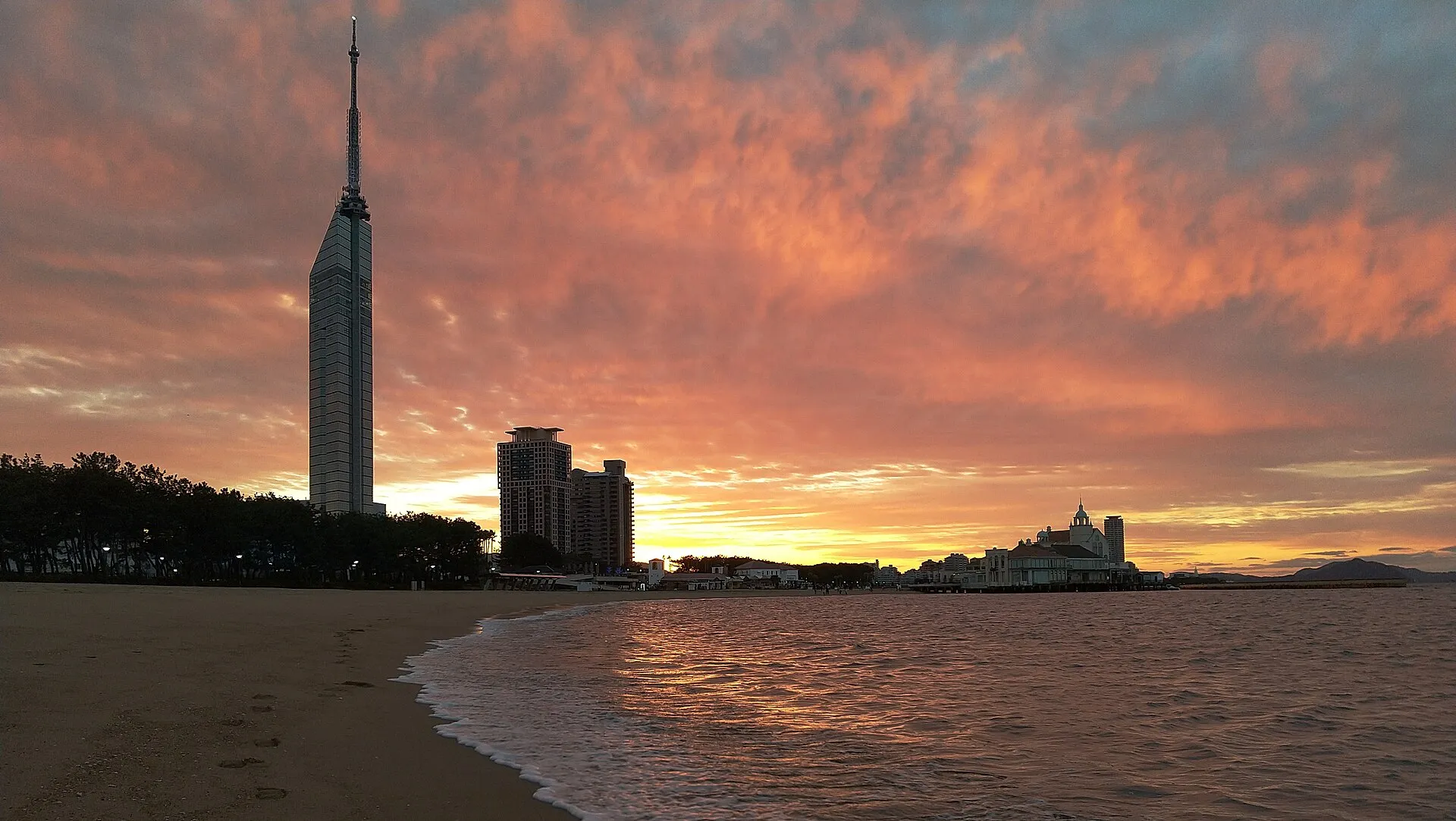
The beach below the tower is the free version of the same view, and the photo most people actually want: the lit tower rising behind the white domes of Marizon, the wedding and restaurant pier, with the sky going orange then navy behind them. Seaside Momochi Seaside Park is free to enter.
What to shoot. Stand on the wet sand at the waterline after sunset and shoot low, so the tower reflects in the sheen left by each wave. Our cover photo is this exact spot at sunset. Then turn east along the promenade for the baseball dome and the hotel towers across the water.
Rules. The beach is fine for a tripod. Fukuoka’s rules for city parks say ラジコンやドローンを飛行させてはいけません, remote-controlled aircraft and drones must not be flown (city park rules), and that covers this park.
This winter. The green promenade in front of the tower hosts Christmas Market ICE WORLD in Momochihama, 20 November 2026 to 6 January 2027, 17:00 to 21:00 on weekdays and 12:00 to 21:00 on weekends and holidays (prefecture’s Christmas Advent listing). Our Fukuoka Christmas market guide has every venue’s dates.
Washio Atago Shrine
Washio Atago Shrine sits on a hill at the mouth of the Muromi River, and the city’s own port-scenery page describes it as founded in AD 72, the oldest shrine in Fukuoka, one of Japan’s three great Atago shrines with Tokyo’s and Kyoto’s, and popular as a night-view spot for the “panorama of light centred on the curves of the urban expressway” with Hakata Port, Nokonoshima, Shikanoshima and Fukuoka Tower all in view (Fukuoka City).
What to shoot. This is the only spot that puts Fukuoka Tower in the frame with the city behind it, which is why it is the local photographers’ choice at sunset. A medium telephoto compresses the expressway curve, the tower and the dome into one layered shot.
Getting there and safety. From Muromi Station exit 1, cross the Muromi Bridge and follow the shrine’s signs up the Onna-zaka route, 15 to 20 minutes; or take a Nishitetsu bus to Atago Jinja-mae or Atago-shita and climb the Otoko-michi from the torii by the stop, 10 to 20 minutes. The shrine also notes an easier path, Atago Sakura-zaka, behind the 7-Eleven on Atago 2-chome (shrine access page). The stairs are steep and dimly lit after dark: bring a headlamp, keep the tripod folded until the top, and remember it’s a working shrine, so no light-painting near the hall. The shrine publishes no evening viewing hours, so treat it as a sunset-and-blue-hour stop rather than a late one.
Nishi Park
Nishi Park got a new prefectural observation facility on 19 July 2026: about 70 m long, 14 m high, 144 steps, built for a 360-degree view from Hakata Bay to the Sefuri mountains and, in the prefecture’s words, the glittering night view of central Fukuoka (Fukuoka Prefecture press release). The park’s own map page gives the facility’s hours as 5:30 to 21:30 (9:00 to 21:30 from October to April), free, with the lights switched off at 22:00, and says the central observation plaza looks over the city, the bay and Shikanoshima (park map).
What to shoot. North over the port: the ferry terminal lights, the Port Tower, ships moving across the bay. It’s the best angle in the city for a long exposure of boat trails.
Getting there. Ohorikoen Station on the Kuko Line, 15 minutes on foot, or the Nishitetsu bus to the Ohori Koen stop, 10 minutes (park access page).
Ohori Park
Ohori Park is the water shot: the pond was the outer moat of Fukuoka Castle, and the chain of islets through its middle, Nakanoshima, is lit every evening from 18:00 to 22:00 (park map). The bridges and pavilions double in the water on a still night, with the Tenjin towers behind.
Rules. Personal photography needs nothing. Photography “as a business” needs a park-use permit filed a week ahead, and the fee for still photography is ¥1,980 per job within a month; video is ¥6,630 for up to 14 days or ¥13,270 for a month; drones are “by separate consultation” (park application page). If you’re hiring a photographer for a couple’s shoot, this is the permit they’ll ask you about.
Getting there. Ohorikoen or Tojinmachi Station, 7 minutes on foot (park access page).
Fukuoka Castle Ruins and teamLab’s light festival
Next door, the stone walls of Fukuoka Castle are the oldest thing in this guide after the shrine. Kuroda Nagamasa, handed Chikuzen after Sekigahara, started building in 1601 and took seven years; the castle had three keep platforms and 47 turrets, and it was nicknamed Maizuru, “dancing crane”, because from the bay its spread looked like a crane’s wings. Little of the woodwork survives but the stone walls and layout are nearly as built, and the Tamon turret is a national Important Cultural Property (prefecture tourism page; Fukuoka City on the Maizuru name).
Those walls are the canvas for teamLab: Digitized Fukuoka Castle Ruins 2026-2027, back for the first time in seven years: 30 October 2026 to 11 January 2027. Hours are 18:30 to 22:00 until 6 November, 18:15 to 22:00 from 7 November to 31 December, and 18:30 to 22:00 in January, last entry 21:30 at all times. Adults pay ¥2,300 on weekdays and ¥2,500 on weekends, holidays and 29 to 31 December, when entry is by reserved time slot; junior and senior high students ¥1,300 / ¥1,500, elementary ¥700 / ¥900, preschoolers free. Eight minutes on foot from Ohorikoen or Akasaka Station (prefecture event listing; organiser press release).
Rules. teamLab sets its own rules for what’s allowed inside; check the event page before you pay, and plan on handheld at high ISO. The artworks are teamLab’s copyright, which is why there is no photo of them here.
Nakasu riverside and the yatai
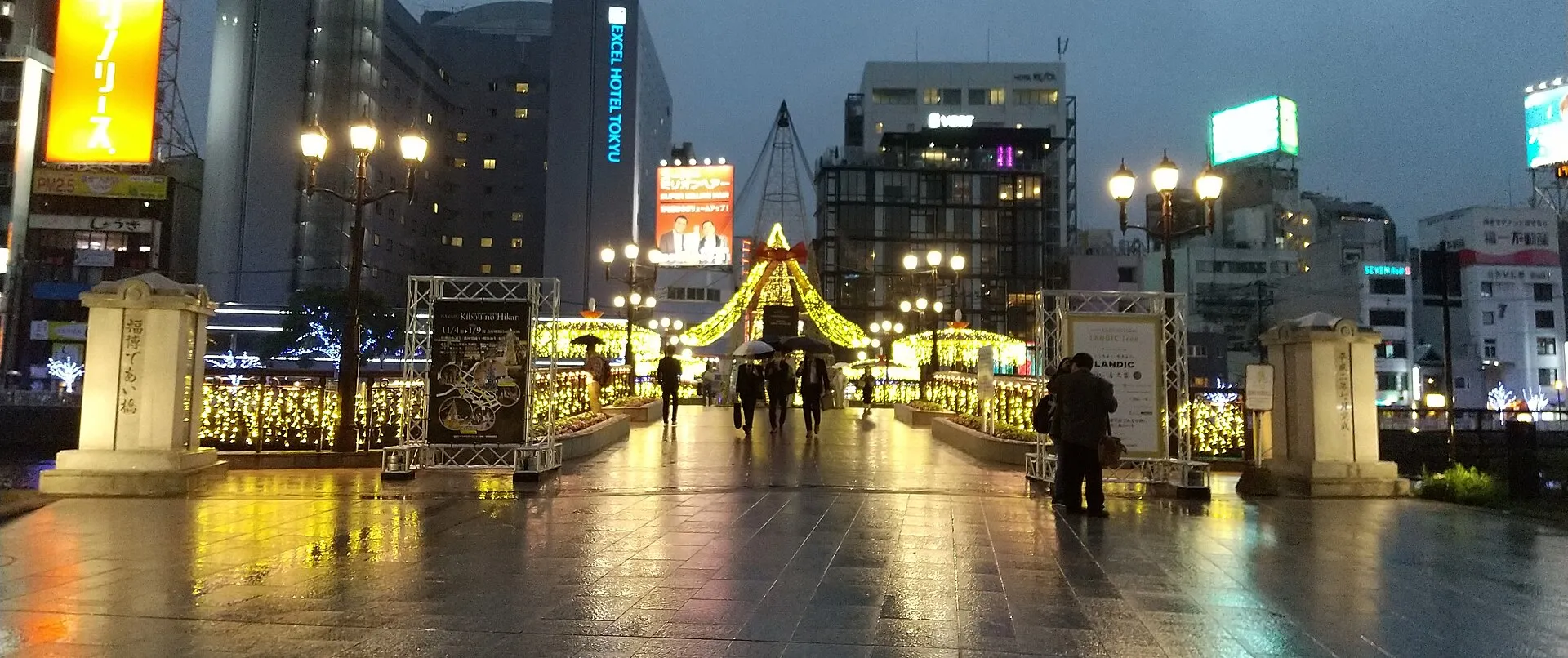
The classic Fukuoka night photo is the island of Nakasu from the Fukuhaku Deai Bridge, the footbridge between Nakasu and Tenjin Central Park: signboards stacked ten storeys high, every one of them reflected in the Naka River. From 2 November 2026 to 12 January 2027 the bridge itself is lit for Nakasu Hikari no Advent, 17:00 to 1:00 (prefecture’s Christmas Advent listing), so the foreground glows too. A tripod on the bridge is fine; keep it to the rail side so people can pass.
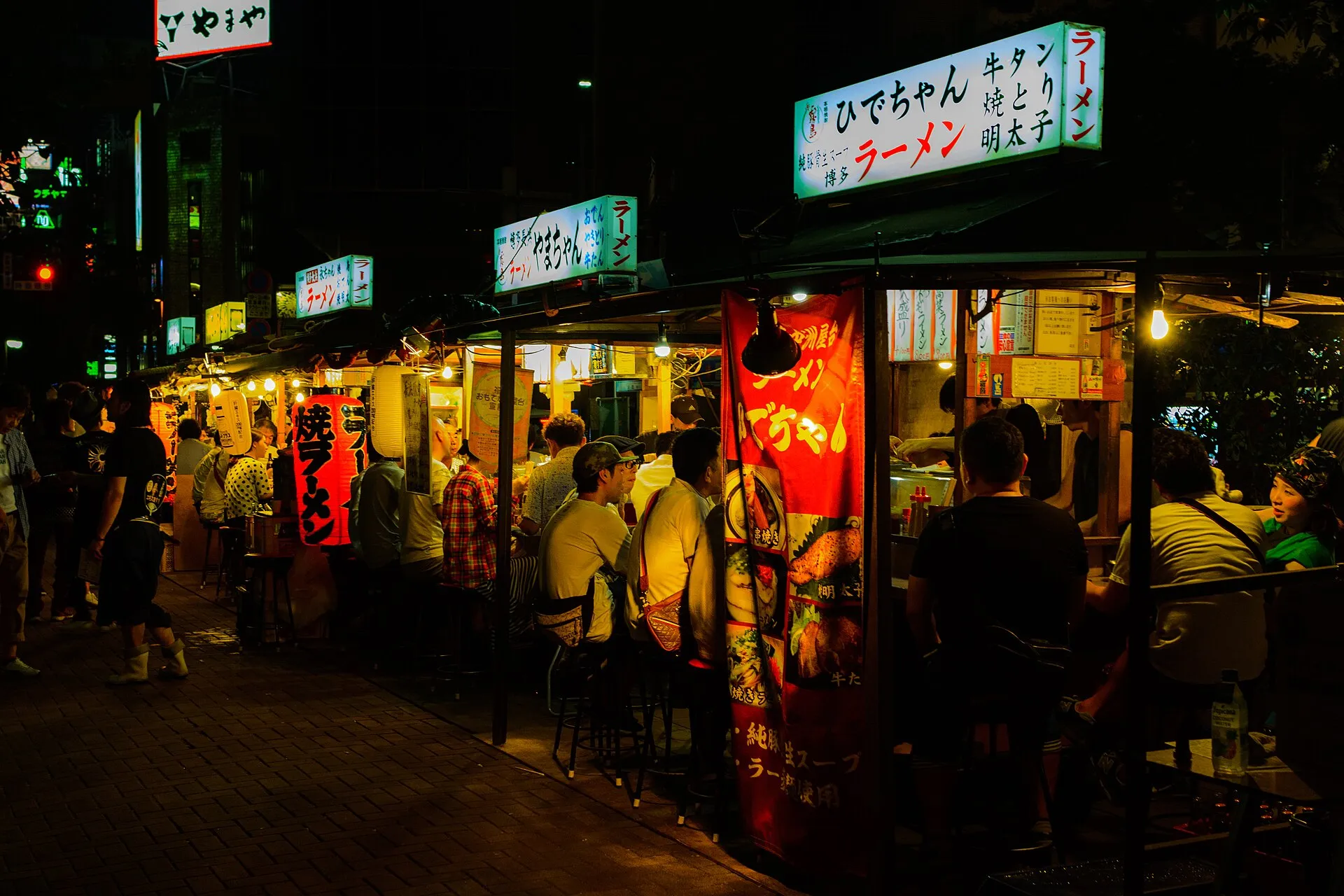
The second shot is the yatai, the open-air stalls along the river’s west bank. Fukuoka’s yatai rules allow a stall to occupy its pitch from 17:00 to 4:00 including setting up and packing away (city rules for yatai operators), so most are lit and serving from about 18:00; on wet or windy nights expect gaps in the row. Shoot from across the lane with a wide lens so the steam and the lanterns and the customers’ backs all land in one frame, and buy a beer at the one you photograph. Nearest subway: Nakasu-Kawabata Station.
Safety. Nakasu is an entertainment district and gets loud after 22:00. The prefectural nuisance-prevention ordinance bans touting for hostess clubs and sex businesses in public places, with fines up to ¥500,000 (Fukuoka Prefectural Police notice), so anyone who approaches you on the street is already breaking it: don’t follow them. Keep your bag on the river side of your body on the bridge and don’t leave a tripod standing while you wander.
JR Hakata City rooftop
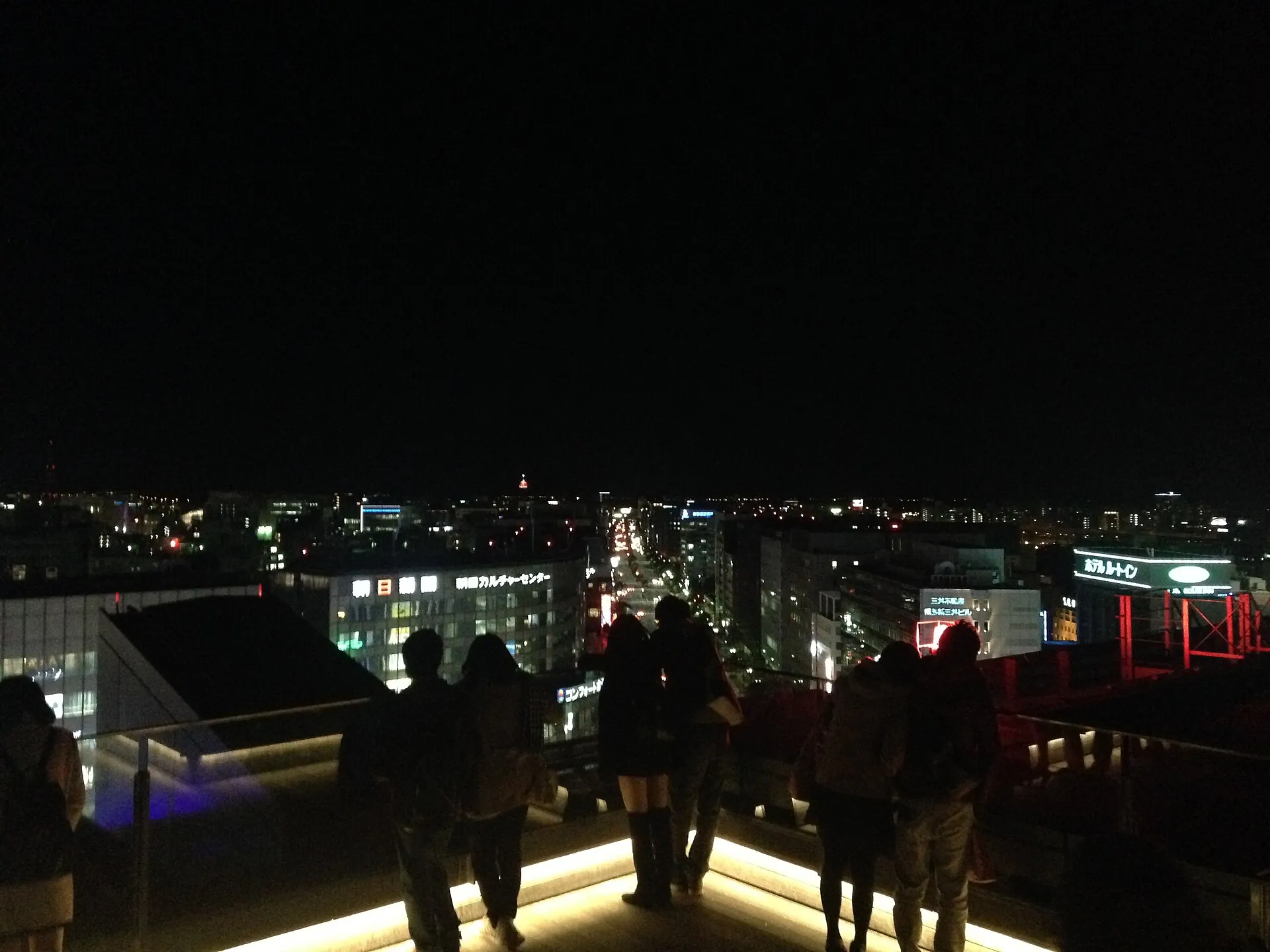
The roof of Hakata Station, Tsubame no Mori Hiroba, is the free view most visitors stand under and never go up to. Open 10:00 to 22:00, closed in severe weather; the little rooftop train that used to circle it has ended (JR Hakata City hours). The station publishes no tripod rule, so use common sense on the railings.
What to shoot. Look northwest: the Hakata grid, the Nakasu glow and the hills behind, with the Shinkansen platforms sliding in below you. From 3 November 2026 to 11 January 2027 the plaza under you is Hikari no Machi Hakata, 800,000 bulbs lit 17:00 to 23:00, with a new centrepiece called the Hakatarium; the switch-on ceremony is 3 November from 18:15, lights on at 18:30 (JR Hakata City). Shoot it from the roof first, then from the plaza.
Hakata Port Tower
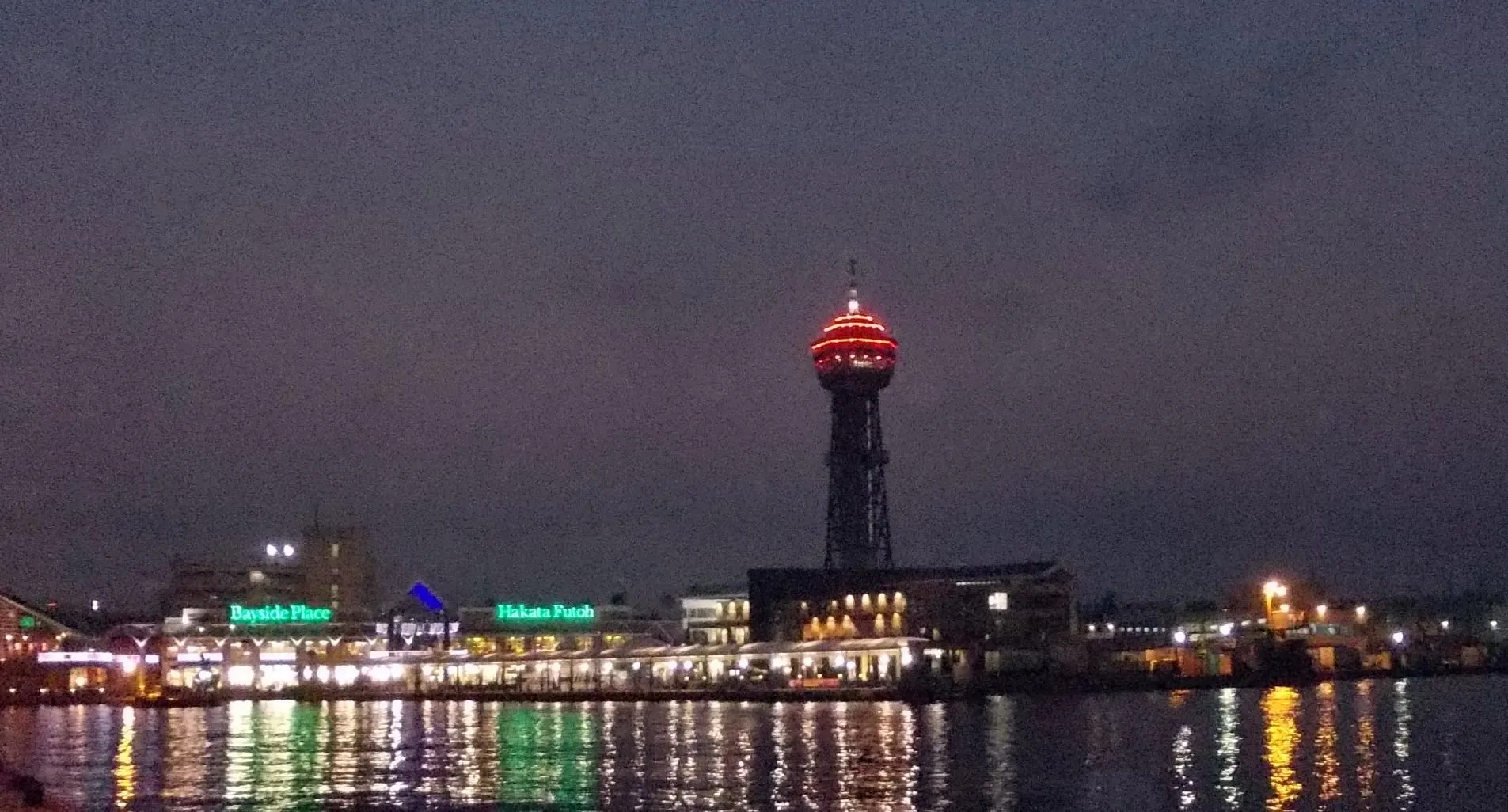
Hakata Port Tower is 100 m tall with an observation room at 70 m, designed by Naito Tachu, the engineer behind Tokyo Tower and Tsutenkaku; the city calls it the youngest of his “six tower siblings” (Fukuoka City port museum page). It went up in 1964 as the lookout of a leisure complex called Hakata Paradise (Walkerplus); today it’s a public facility, and admission is free.
Hours. 10:00 to 20:00, last entry 19:40, closed Wednesdays (the next weekday when Wednesday is a holiday) and 29 December to 3 January, admission free. The tower itself is lit 18:00 to 24:00, with a colour calendar: orange through November, red 1 to 7 December, green and rainbow 11 to 25 December (light-up schedule).
What to shoot. The 20:00 close sounds early, but in November and December sunset is before 17:30, so you get the whole blue hour from inside: the Busan ferries at their berths, the bay, the tower’s shadow over Bayside Place. Then come down and shoot the tower itself in that night’s colour from the wharf.
Getting there. Nishitetsu bus from the Hakata-eki Nishi-Nippon City Bank-mae F stop to Hakata Futo (Bayside Place), about 20 minutes, or from Tenjin Solaria Stage-mae 2A, about 10 (access page).
Fukuoka Airport observation deck
The airport is two subway stops from Hakata, and the domestic terminal’s 4F deck is open 7:00 to 22:00, free, and closed in bad weather (airport deck page). It’s an urban airport with the runway right there, so after dark you get approach lights, the blue taxiway lamps and the city behind. Flying a drone anywhere around the airport is prohibited by law (airport rules); the airport publishes no tripod rule for the deck, so ask staff if you want to set one up. Ride the Kuko Line to Fukuoka Airport Station.
The 2026-27 light calendar
| Illumination | Dates | Lit |
|---|---|---|
| teamLab, Fukuoka Castle Ruins | 30 Oct 2026 to 11 Jan 2027 | from 18:15 or 18:30, last entry 21:30 |
| Nakasu Hikari no Advent, Deai Bridge | 2 Nov 2026 to 12 Jan 2027 | 17:00 to 1:00 |
| Hikari no Machi Hakata, Hakata Station | 3 Nov 2026 to 11 Jan 2027 | 17:00 to 23:00 |
| Watanabe-dori illumination | 12 Nov 2026 to 31 Jan 2027 | 17:00 to 24:00 |
| Fukuoka Tower Christmas tree | 20 Nov to 25 Dec 2026 | 17:00 to 23:00 |
| ICE WORLD market, Momochihama | 20 Nov 2026 to 6 Jan 2027 | to 21:00 |
| Hakata Port Tower colours | all year | 18:00 to 24:00 |
| Ohori Park Nakanoshima | all year | 18:00 to 22:00 |
Sources are the venue pages linked above and the prefecture’s Christmas Advent listing. The events calendar tracks what’s on across Fukuoka and Kitakyushu.
Tripods, drones and permits in one place
- Tripods: refused at Fukuoka Tower. At teamLab, check the organiser’s current list. Not mentioned by Nishi Park, Ohori Park, the station roof, the Port Tower or the airport, so be unobtrusive and move if asked. Fine on the beach and the Deai Bridge.
- Drones: banned in every Fukuoka city park, which includes Momochi, Nishi Park and Maizuru Park; “by consultation” at Ohori Park; prohibited by law around the airport. There is nowhere in this guide to fly one.
- Paid shoots: Ohori Park charges ¥1,980 for stills with a permit filed a week ahead. Fukuoka Tower takes pre-wedding and commercial requests through its form. Everywhere else, a hired photographer should ask the venue.
Three night routes
West, for the tower. Muromi Station at 16:00, climb to Atago Shrine for sunset over the tower, down and along the river to Momochi beach for blue hour, then up Fukuoka Tower by 19:00 for full dark. Bus 306 back to Hakata.
Centre, for the water. Ohori Park at 17:30 for the Nakanoshima lights, Nishi Park’s deck by 18:30 for the bay, teamLab at the castle by 19:30 (last entry 21:30), then a walk into Tenjin.
Hakata, for the river. Hakata Port Tower at 17:00 for blue hour from the deck, bus to Tenjin and across to the Deai Bridge by 18:30, yatai dinner on the Nakasu bank, and the Hakata rooftop before its 22:00 close with the illumination in the plaza beneath you.
A tour, or a photographer
If you’d rather someone else handle the timing, Klook’s Fukuoka night tour with a Naka River cruise and yatai dinner covers the river, the stalls and the tower’s view in one guided evening, and the Fukuoka Open Top Bus runs a night course past the tower and the lit waterfront. More on the tours hub.
For a base, Momochi puts you under the tower and Nakasu puts you beside the river: compare Momochi hotels on Booking.com, Nakasu on Agoda, or everything near Hakata Station on Booking.com.
Beyond the city: the view that beats them all
Every spot above looks at Fukuoka from inside it. For a night view that looks down on a whole city from 622 m, go an hour east to Mt. Sarakura in Kitakyushu, one of Japan’s New Three Great Night Views, where you can push a travel tripod through the fence rails and shoot the Kanmon Strait. The Karato Market and Mt. Sarakura day tour from Fukuoka times the summit for sunset, or do it yourself with our Fukuoka to Kitakyushu guide.
FAQ
Which Fukuoka night view is best for a first visit? Fukuoka Tower for the overview, then the beach below it for the photo you’ll keep. If you have one evening, do the west route.
Is Fukuoka Tower worth ¥1,000 at night? Yes on a clear night, and especially at blue hour, which you can’t get for free at that height anywhere in the city. On a hazy night, Hakata Port Tower’s free deck gives you the same mood at 70 m.
Can I shoot with a tripod in Nakasu? On the Deai Bridge and the riverside paths, yes; nobody regulates it. Keep it out of the walkway and away from the yatai queues.
Where do the locals go? Atago Shrine at sunset and the Hakata rooftop on a weeknight. Both are free and neither is in most guidebooks.
What about rain? Fukuoka Tower and the Port Tower are indoor. Wet pavement is a gift in Nakasu: the reflections double. Nishi Park’s deck and the airport close in severe weather.
Start at the beach at sunset, climb something, and finish beside the river. Fukuoka’s night is built to be walked through.
Book the Fukuoka night cruise and yatai tour on Klook →Booking through this link supports KitaQ.Travel’s research and photography at no extra cost to you. Every Fukuoka and Kitakyushu tour we’ve covered is on the tours hub, and the Fukuoka sights hub has the daytime side of the city.
FAQ
What is the best free Fukuoka night view?
Hakata Port Tower's deck at 70 m is free, and in November and December its 20:00 close still gives you sunset and blue hour from inside. Nishi Park's new observation facility (free, open to 21:30) and Seaside Momochi beach, with Fukuoka Tower lit until 23:00, are the other two free views worth a trip.
Can I use a tripod at Fukuoka Tower?
No. The tower's FAQ says tripod photography is refused in the observation room, and there's no re-entry once you leave. Brace the camera on the window frame instead. Commercial and pre-wedding shoots need an application through the tower's form.
When should I arrive for a Fukuoka night view in winter?
The sun sets around 17:25 on 1 November, about 17:10 at the end of November and 17:10 to 17:20 through December. Blue hour, the best light for city photos, is the 20 to 30 minutes after sunset, so be in position by 17:00.
Are drones allowed at Fukuoka's night view spots?
Not at any of the spots in this guide. Fukuoka city's park rules ban flying drones in its parks, which covers Momochi, Nishi Park and Maizuru Park; Ohori Park asks you to consult the office first; flying around the airport is prohibited by law.
How do I get to Fukuoka Tower at night by bus?
Nishitetsu bus 306 from stop 6 at Hakata Bus Terminal takes about 25 minutes; W1 or 302 from stop 1A at Tenjin Bus Center takes about 15 minutes. Get off at TNC Hoso Kaikan-mae or Fukuoka Tower Minami-guchi. The tower is open 9:30 to 22:00, last entry 21:30, adults ¥1,000.
Photo credits
- Seaside Momochi beach at sunset with Fukuoka Tower and the Marizon domes against an orange sky: Hirho, CC BY-SA 4.0, Wikimedia Commons
- Fukuoka city lights at night seen from the Fukuoka Tower observation room: Suicasmo, CC BY-SA 4.0, Wikimedia Commons
- The Nakasu skyline reflected in the Naka River at night, seen from the Fukuhaku Deai Bridge: Hirho, CC BY-SA 4.0, Wikimedia Commons
- A row of Nakasu yatai food stalls lit up at night along the river: Yoshikazu TAKADA, CC BY 2.0, Wikimedia Commons
- View northwest over the lights of Hakata at night from the rooftop of the Hakata Station building: そらみみ, CC BY-SA 4.0, Wikimedia Commons
- Bayside Place Hakata Wharf and the red Hakata Port Tower lit up at night: STA3816, CC BY-SA 3.0, Wikimedia Commons


